
Making communities central to water smart housing
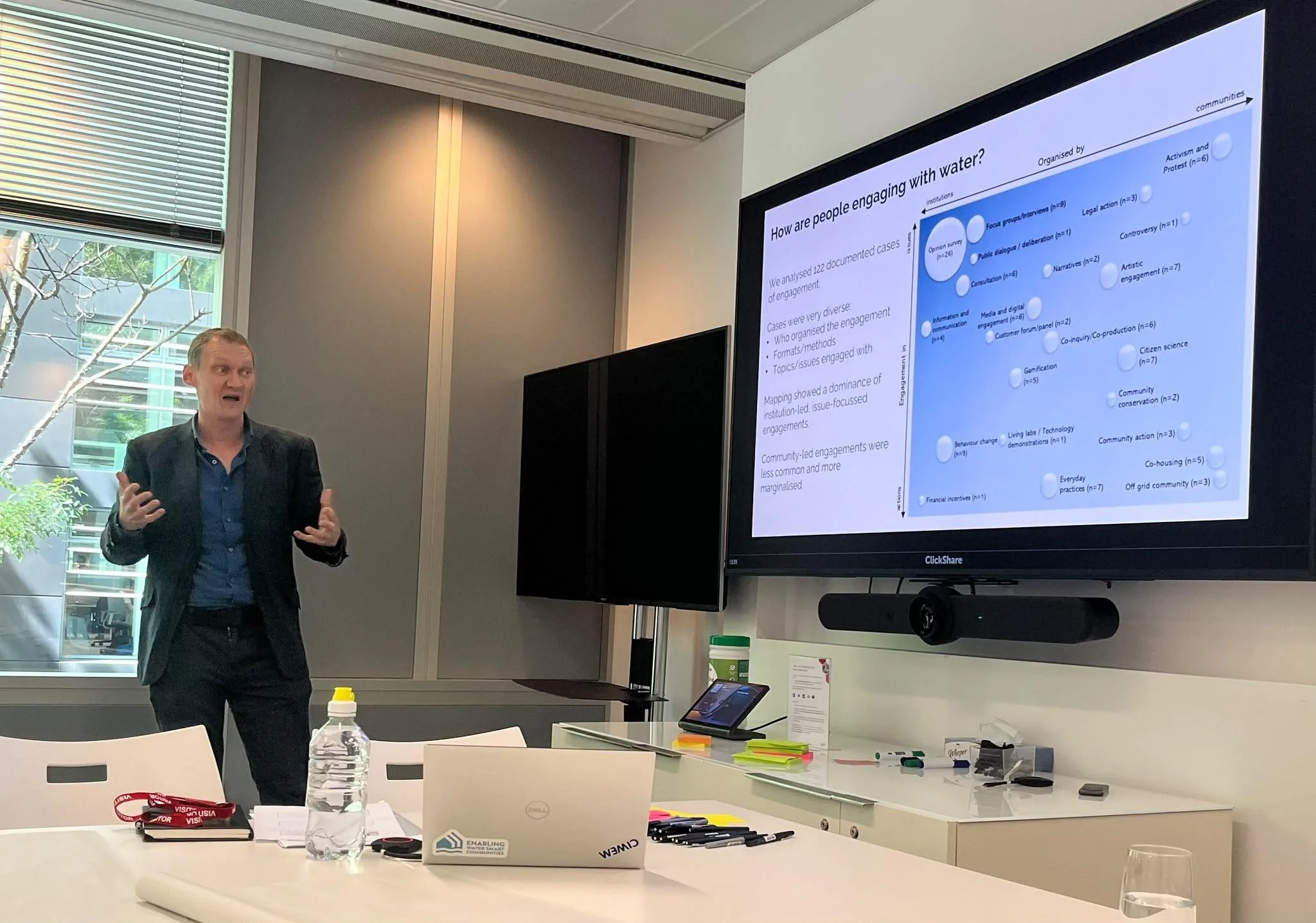
Bringing together housing and water industry professionals to discuss how to make communities central to water smart housing
Addressing contemporary water challenges demands effective community engagement. Poor community engagement risks project delays, failure and even abandonment. It can also lead to public resistance and protests, damaging trust and souring relations often for many years. Conducting effective public and community engagement was therefore recognised as absolutely central to the challenge of Enabling Water Smart Communities (EWSC).
Research work led by the Universities of Manchester (UoM) and East Anglia (UEA) tackled this issue head-on. To round off the research, on 29 June 2026 UEA and UoM hosted a workshop with housing and water industry professionals to discuss how to make communities central to water smart housing.
Research Insights
The morning was devoted to sharing insights from the research. Dr Tom Hargreaves (UEA) shared how, despite advances in how the water industry undertakes public engagement, existing forms of engagement often leave only narrow, reactive roles for people to play in relation to water and typically overlook more diverse forms of community-led action. UEA’s research concluded that there is a need for greater institutional responsiveness to public priorities and concerns. This starts from understanding diverse already-existing forms of engagement and being open to the different problem-framings, ideas and innovations they often provide.
Dr Claire Hoolohan (UoM) showed that prospective residents and professionals share an appetite for transformative changes in water and housing, there are then diverse perspectives on exactly what this change should mean. Some emphasise self-sufficiency, others techno-fixes and supply-chain solutions. Some foreground joined-up and long-term solutions, seeing water smart communities as part of a solution to neighbourhood decline and climate resilience. Others emphasise the need for high-quality construction, governance and maintenance.
UoM work concluded that industry plans for water smart communities imagine extensive technical change, but it’s important also to think of water smart communities as spaces to reimagine ways of living with water, where new meanings and practices can be formed, and where social relationships can be reconfigured to better support the achievement of social and environmental outcomes.
Professionals’ Perspectives
The afternoon session took the form of an interactive workshop. Participants addressed the question: “How can we make households and communities central to the future of sustainable water in new homes?”
In response, participants identified 5 core priorities that should be seen as central to the challenge of enabling water smart communities.
Install ‘water smart stuff’ as standard and develop the skills to sustain it. Climate-resilient gardens, rainwater tanks, recirculating technologies and smart showers (not the kind that tell you you’ve used too much water, but the kind that can tell when no-one is in the shower and adapt the pressure). Many water-smart solutions already exist, and are tried, tested and easily scalable. Many are relatively low-cost. Rather than trying to persuade individual households to install these, use new housing developments as spaces to normalise these. This requires more ambitious building standards, as well as skills development for tradespeople, estate managers, contractors and DIY-ers.
Ensure that engagement with communities is meaningful. Effective communication needs to be a genuinely 2-way process. It should begin by learning about the existing ways that communities engage around water, what their concerns and priorities are, and how they can be supported before any attempt is made to educate or inform. Engage in long-term collaborative processes to develop initiatives that address genuine local concerns. Education and communication should recognise the tacit understandings households and communities have, and be honest and transparent about urgency and need for change.
Don’t push responsibility onto consumers. Communications won’t work if people are hearing ‘use less water’ while others are promoting water intensive practices (e.g. manufacturers and retailers of water-intensive spa style showers), and there is a need for stronger societal signals that convey the urgency of water scarcity. Linking to important moments (like heatwaves) might be beneficial initially but can also make sustaining water-sensitive practices more difficult when ‘normal’ weather resumes.Be more ambitious with ideas about living differently. Many people are unsatisfied with current social existence, even if not always for the same reasons. Water Smart Communities can be a way to connect with like-minded others and live different lives. While not everyone is interested in living in a cohousing project, some are (perhaps more than we imagine) and many people seek social cohesion, sharing and support networks that water smart communities promote. Even engaged communities require support, so as well as imagining alternative futures, considering how these can be enabled.
Consider water cultures over the long-term. It is easy to see fault in today’s ways of living, and also easy to look back to times when society was more frugal in its water use (“we used to share a weekly bath!”). Yet, it remains difficult to imagine futures that are different to today. At the same time, many people are already living differently with water. Young children refusing a bath, migrant households with living memories of scarcity, people living off-mains, those choosing to wash their hair less frequently, influencers promoting traditional ways of living with local environments. A longer view of water cultures aids imagination, and helps identify those working for and against those futures.
Practice early, integrated and long-term spatial planning. There’s an important need to move beyond one-size-fits-all approaches to planning future water developments that are disconnected from other development needs and services. Different communities in different times and places will respond differently to the same solution. As such, planning needs to be bespoke to particular areas and communities and must start with engagement to understand that community’s concerns and priorities.
It means adopting long-term planning horizons that anticipate how climate change will result in different concerns and priorities. Doing this effectively means adopting a holistic and integrative approach when planning landscapes, infrastructure, services, businesses and homes.
Find out more and get in touch
If you want to learn more about the research, take a look at the one-pager on ‘Making Community Central to Water Smart Communities’.
For a more in-depth understanding, take a look at the University of Manchester’s report on ‘A people-centred perspective on enabling water smart communities’ or the University of East Anglia’s report on ‘Making Water Smart Communities Work’.
Please reach out to us at policy@ciwem.org if you’re keen to find out more.
—
To keep in touch with EWSC, and be part of our ongoing 'Community of Practice', which will be linked to the work of the Water Smart Growth board, use the link below: