
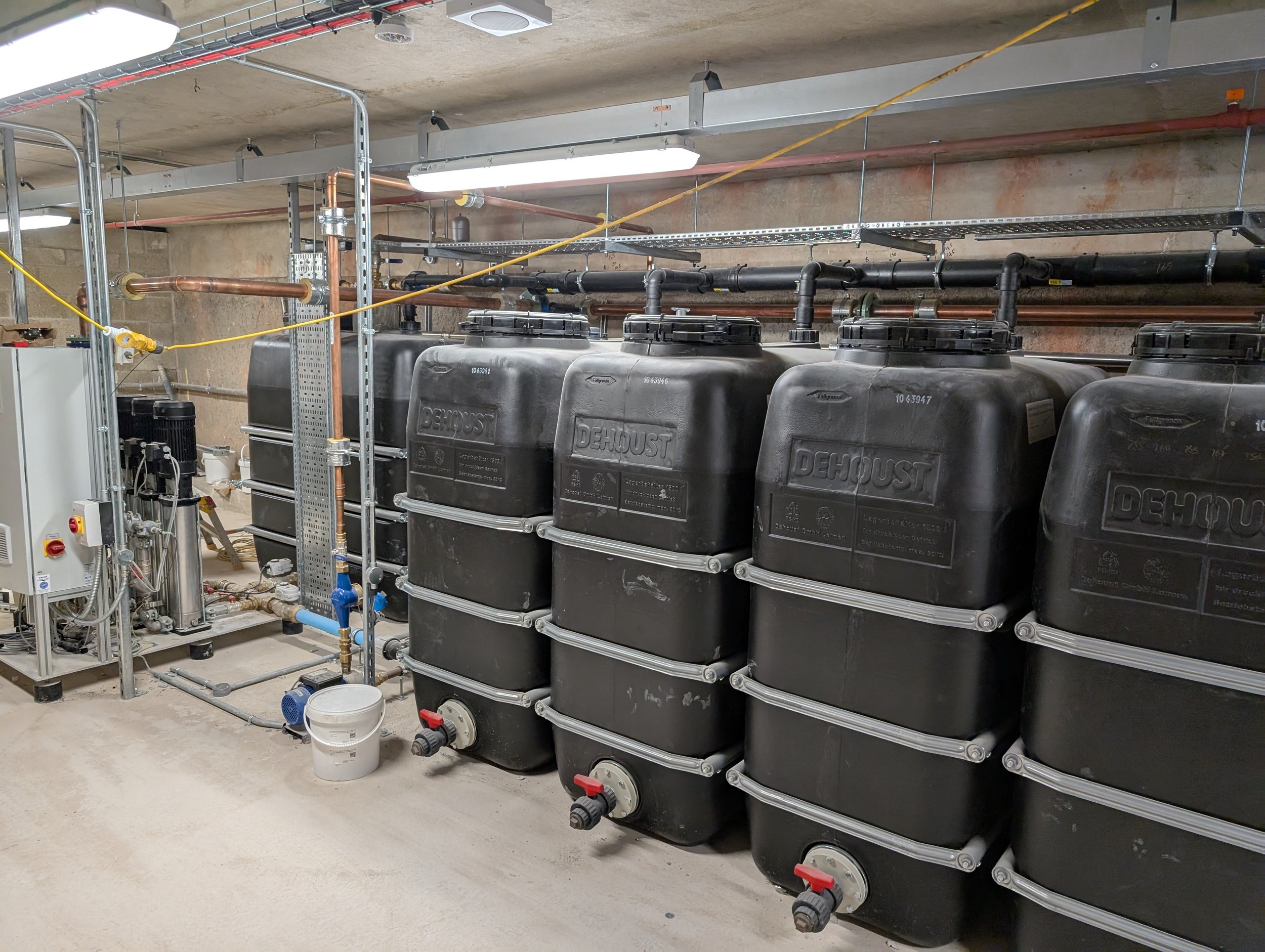
Water reuse is increasingly recognised as a vital part of creating sustainable, resilient urban areas. When designed and operated well, reuse systems can significantly reduce demand for potable water while supporting ambitious environmental goals.
This case study blog looks at a major mixed-use development in central London that took an early and voluntary step into water reuse. While the journey was not without challenges, it offers valuable lessons that are helping shape better, more reliable reuse systems today.
Starting with ambition
From the outset, the development set out to deliver strong social, economic and environmental benefits to its community. Achieving a BREEAM Excellent rating was central to this ambition, alongside alignment with the London Plan’s encouragement to reuse rainwater in new developments. Rather than treating water reuse as an optional extra, the project team chose to embed greywater recycling, rainwater harvesting and cooling tower blowdown reuse into the design and planning application – even though these systems were not explicitly required. This decision demonstrated leadership with an ambition to help normalise water reuse in high-profile urban developments.
Reflecting on the construction phase
During construction, the reuse systems were seemingly successfully installed across the development. However, once occupied, some systems proved difficult to operate as intended.
At the time of construction, industry experience with large-scale reuse in mixed-use buildings was still developing, and collaboration across stakeholders was limited – so the reuse system was installed without much guidance. In hindsight, the following considerations would have aided the design and construction phases:
early engagement with water companies and operators;
thorough testing during construction;
clear plans for commissioning and handover.
Learning through operation
Responsibility for long-term operation was not clearly defined during handover from construction. Once occupied, technical issues arose resulting in the reuse system being turned off. Rather than indicating that water reuse does not work, this experience reinforced a key message:
Successful water reuse depends as much on governance and stewardship as it does on engineering.
Unlocking potential in cooling and rainwater systems
Cooling systems represent one of the biggest opportunities for non-potable water reuse in commercial buildings. At this particular development, the cooling tower blowdown reuse and rainwater harvesting systems were installed but not fully brought into operation. Challenges such as water chemistry and treatment membrane durability limited performance of the water treatment system, and the underlying infrastructure remained in place without being fully utilised. Importantly, the case demonstrated:
where reuse can deliver the greatest water savings;
how water treatment must be tailored to source water and system design;
the value of designing flexibility into reuse infrastructure to enable a blend of water sources and thereby maximise output and minimise use of potable water.
These lessons can help inform newer schemes where cooling water reuse can provide a potentially reliable source of water.
Greywater reuse in residential buildings
The residential greywater systems provided further learning opportunities. A cross-connection between the greywater and potable water systems materialised which was difficult to identify post-occupation and resulted in the reuse system being switched off. This highlighted the need for enhanced monitoring, clearer labelling and more rigorous verification before systems go live. While resolving such issues in occupied buildings is challenging, the experience has directly influenced improvements in:
pipework labelling;
commissioning start-up processes such as dye testing, checking monitoring equipment is operable; developing guidance for system operation and maintenance;
ongoing water quality monitoring.
These improvements significantly reduce the risk of cross-connection and can increase confidence in future residential reuse schemes.
A step change in a new residential block
The most encouraging outcome came with the construction of a new residential block within the same development. This time, the water reuse system was delivered by a contractor with extensive experience in similar systems. Lessons from earlier phases were fully applied, resulting in:
compliance with BS 8525-1 (greywater systems);
advanced digital monitoring systems;
clear QR code labelling of reuse infrastructure;
reuse system information included in resident handover packs.
This phase demonstrated how quickly water reuse can evolve when experience is shared and lessons are carried forward.
Lessons for future projects
This development shows that water reuse is not something to avoid,it is something to learn, refine and improve.
Key takeaways include:
Plan for operation, not just installation
Define ownership and responsibility early
Invest in monitoring and data visibility
Engage building users to build understanding and trust
When these elements are in place, reuse systems can become reliable, valued assets rather than overlooked infrastructure.
Looking ahead
The focus now is on ensuring that newer reuse systems remain active and deliver real, measurable benefits. This includes understanding actual potable water savings, embedding fair charging mechanisms, and ensuring long-term stewardship is clearly defined.
Water reuse will play an essential role in addressing water scarcity and climate resilience in cities. Experiences like this are not cautionary tales;they are stepping stones towards systems that work better, last longer, and deliver greater value. The opportunity is clear. The challenge is to keep learning,and to make sure we apply those lessons every time.
—
To learn more about EWSC, and our upcoming Community of Practice, sign up to our newsletter or get in touch at policy@ciwem.org.