
Reimagining water demand: From buildings and behaviours to passports and points

Distributed ledger technology is a funny thing. On the surface it looks vaguely useful but just not quite sure how. But its strangest effect has nothing to do with what it does or how it works. Rather, it is what it does to your eyes.
When we brought DLT into a recent EWSC workshop, what followed was energising in the way that seeing the world in a new light always is. The conversation ranged across emergency demand coordination, resource zone trading, environmental incentives, nutrient markets, stormwater optimisation, incentivising data quality improvement and more, not because the technology suggested each of these, but because participants could see how its fundamental characteristics could open new doors.
Transparency. Immutability. Independence from any single institution. Tokens. Smart contracts. These things build trusted, shared facts, and once you see that clearly, a deeper insight follows: shared problems cannot be solved with single-party solutions.
While there were plenty of ideas, environmental incentives emerged as the priority target.
The challenge: incentives that exist but don’t land
Environmental incentives exist today. Financial payments to developers to build water-smart homes, rainwater harvesting, water reuse, sustainable drainage, and more.
And yet uptake is minimal. Many developers do not know the incentives exist. Incentives are inconsistent, vary widely between water company regions, are unclear in their criteria, and difficult to navigate. There is no single place to find them. No shared framework that makes the system trustworthy and accessible at scale. No connection between building and occupancy, and an administrative overhead that is premised on centralised compliance rather than self-assertion.
The consequence is simple: environmental incentives are underachieving despite the best intentions.
The first rabbit hole: a passport for every building
Through DLT eyes, a different pathway takes shape. What if every building carried a record? A persistent, verified account of its water performance, attached to the property, not the developer, not the occupant, updated as systems change, visible and trusted by everyone who needs it.
Think of the Energy Performance Certificate on every property listing. Before it existed, two identical-looking homes could have wildly different energy costs and nobody could tell. The EPC simply made something invisible, legible. And from that single act of visibility, everything downstream became possible. Developers designed to it. Lenders priced against it. Residents finally understood what the building itself contributed to their bills.
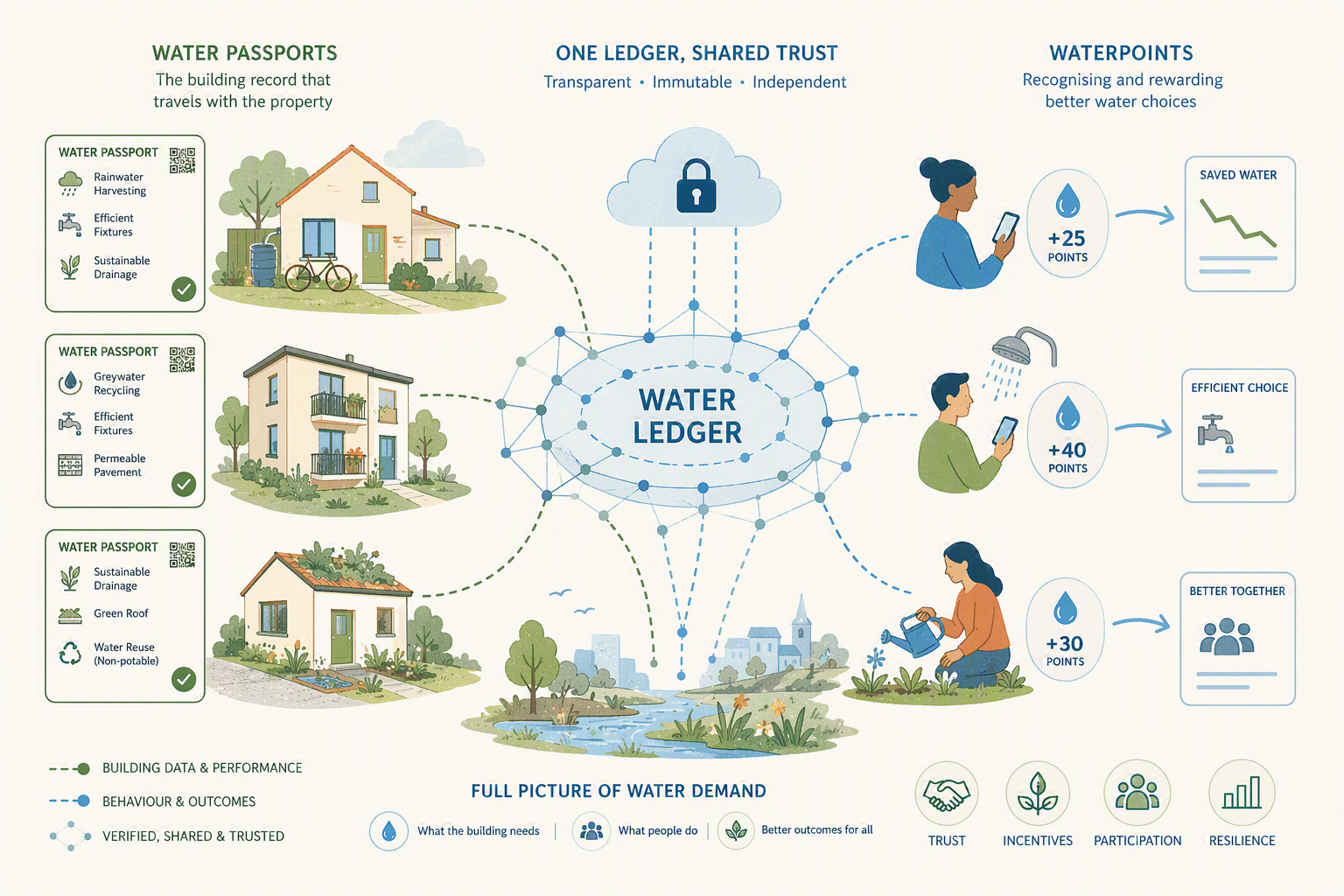
A water passport for a building does the same thing and goes further. It travels through every sale and tenancy. When a developer installs a rainwater harvesting system, they assert it on the ledger. An independent auditor verifies it. A stamp is added to the passport. A smart contract releases the incentive payment. Automatic. Immediate. Certain. No chasing. No question about whether the claim is real.
The passport answers a question that currently has no reliable answer: given what this building is, how much water should it need? That answer - durable, trusted by all parties, impossible to dispute - is the foundation that environmental incentives have been missing.
But once you have that foundation, something else comes into view. The passport records what the building is. It says nothing about what happens inside it. And that is where the second rabbit hole opens.
The second rabbit hole: points for people
Buildings set the floor. Their fixtures, layouts, and systems quietly determine how much water is needed to live or work in them, and that floor is locked in for decades regardless of who moves in. But behaviour lands on top of that floor. What people actually do, day to day, determines where demand ends up. The passport captures the first. What captures the second?
Each customer – household or non-household – gets a reference water budget. Not a ration. Not a legal limit. A shared expectation, calibrated to their building and local conditions. Use less than it and the saving returns to the shared system which is real, collective, immediate. Go further and improve the building itself for example by installing a more efficient fixture, a fixed leak, an upgraded appliance, and the passport is updated to reflect it. Both acts count. Both are recorded on the same ledger.
Think of an airline loyalty programme. Every flight earns points, not money, not a tradeable asset, but recognition that your choices have value. Those points translate into something tangible: an upgrade, a lounge, access to something you would not otherwise have. The relationship shifts. You stop being a passenger paying a fare and become a member whose behaviour is noticed, recorded, and rewarded.
WaterPoints work the same way. Saving water stops being a private act of virtue with no visible return. It becomes a legible contribution to a shared system which is acknowledged, reciprocated, on the record. The relationship between customer and utility shifts from ratepayer to member. That shift matters as much as any efficiency gain it produces.
Two rabbit holes. One ledger. A world of opportunity.
Each rabbit hole is interesting on its own. The passport makes environmental incentives verifiable, durable, and consistent. The points mechanism changes the customer relationship from passive to active. But put both on the same ledger and something genuinely eye-opening happens.
For the first time you can see the full picture of demand at any address. What the building structurally requires. What the occupant contributes on top. How both are changing over time. That is the demand signal utilities have never had – and it opens doors that neither instrument could open alone. Verified savings become assets developers can trade. Occupants with surplus can exchange with neighbours in shortfall. Green infrastructure and SuDS fold into the same accounting framework. Non-household customers, commercial, industrial, agricultural, join on the same terms.
Through our DLT eyes that is the horizon we can see today. And like any good recipe, the classic version comes before the variations. Master the passport. Layer in the points. Prove the concept. You do not attempt the signature sponge before you understand the basic cake.
The journey of a hundred miles
The infrastructure to deliver this already exists with proven in operational water governance contexts across multiple countries, handling rights, usage, trading, and obligations at scale. The passport, the budget, the points mechanism: a new token service awaiting design and deployment.
Yet, as with any journey, especially one into the unknown, the hardest part is taking the first step. Our natural instinct is to wait for someone else to take it, for the regulatory framework to give permission, for the sector to form a view, but the reality is that waiting for someone else to take that first step is simply a recipe to tread water at best or do nothing at worst.
The EPC did not wait for perfect conditions. It created the conditions that define a sector. Equally, water smart communities do not emerge from policy documents and sector roadmaps. They emerge from someone deciding to take the first step.
If this resonates, join us in the race to be first!
—
Fraser MacLeod is co-founder of Water Ledger Global.
Read the latest report from EWSC on this topic: Tokenising Water Smart Communities. To learn more about this project, and future ones, sign up to our newsletter here or get in touch at policy@ciwem.org.